Friday, April 28, 2006

Reading Test

Today's blog entry celebrates two events: Finals week, and several of my friends' upcoming marriages.

The topic? This essay on marriage by John Yoder, a Mennonite theologian. His name rings vaguely familiar, so he may be quite well known.

What can I say? It is long, and a bit challenging to read. (Actually, the first three-fourths were the best; the last 'Parallel Reasoning' part didn't resonate.)

It's a hard article to do justice to, but here's a few points of interest. First, he defines three different views on marriage:
Ontological: A marriage is permanent as long as its 'essence' is maintained, but if the essence is broken, then the marriage is invalid. For example, a marriage is valid as long as both spouses do not commit adultery.
Realist-objective: Marriage is fundamentally determined by powers beyond human control...and the call to live up to the ideal is present regardless of the current state of the marriage.

(As a sidenote to this definition, but a theme throughout the article is the notion that sexual union is a sufficient condition for a marriage relationship. For readers going 'madness!', read the article, it isn't as crazy as I just made it sound. He also argues that while sexual union is sufficient, not all 'marriages' are viable...very fascinating.)

Realist-legal: Essentially argues that the essence of the first marriage always holds, and therefore any additional marriages (or remarriage without a spouse dying) are sinful.

I like what the author does in arguing for the second perspective, trying to stay well away from legalism ("What must my spouse do before I can divorce her?") and calling Christians to a higher vision of marriage. I also like the way the ideas of grace and mercy are woven in regarding remarriage. I don't know if I entirely agree, but it's thought provoking.

Here's another excerpt regarding community that got me thinking.
Most discussion of this issue [marriage] neglects the support which church and community owe to single people. The modern idea that a single person is somehow unfulfilled, unbalanced, unwanted needs to be attacked as an idea and undermined in practice. There should be patterns of community relations in which single persons (whether divorced or never married) would be "at home" as part of a wider "family," and would be recognized for their special contribution. If such resources were available to single persons, there would be fewer "bad marriages," and the divorced would be helped to live without overwhelming pressures toward remarriage.
Attacking the unfulfilled single idea in idea is fairly easy. Undermining it in practice, however, strikes me as exceedingly difficult. I'm tempted to do a brief poll of my peers and see whether they would describe themselves as 'recognized for their special contribution in a wider church family in which they consider at home.'

I need to think more about what it actually takes to undermine the unwanted/unbalanced/unfulfilled single concept is practice. Cheaper gas, perhaps. Fortunately, electrons are plentiful (and thus, cheap) so I can blog on the thought again.

Tuesday, April 25, 2006

The Type of Motivation


Related to gender differences in sin, I came across this Slate article today. Interesting, with a healthy dose of salt...I'm a bit skeptical of statistics in the hands of people.

So related to my last post, I've been thinking about different types of change we under go...and my motivation for different types. For example, I wear different clothes at my current job than my previous one. It is a change, but a fairly meaningless one. I didn't loose sleep over the matter, consider not taking the job, or even really consider the cost. For all intents and purposes, my work dress style (or lack thereof?) is a cosmetic change.

Now some cosmetic changes are harder. I have friends who have finally seen the light and are forsaking their loyalty to the University of Michigan and becoming die-hard Michigan State Spartan fans. Well, at least fair-weather Spartan fans. At some level, this change is purely cosmetic - new clothes, new cheers, new bumper stickers. But it's a harder change...they have attachments that go with being Wolverines and it's hard to abandon those. If I was writing a self-help book, I would come up with a witty and clever name like connection changes to describe this category.

And then there are character changes. (See, I'd make an author because I can make all three of my points start with the same letter, which supposed to help memory or something...or else just makes editors happy so that books get published.) Character changes have to do with forsaking parts of our own identity. I don't want to be less witty in order to be empathetic; funny is part of who I am. I don't want to take risks and looking irresponsible; organized and together is part of who I am. I don't want to complain less; being open is part of who I am. Even when I think the character change is completely a good way, it's uncertain and nebulous...and that's not part of who I want to be.

Usually I find the cosmetic, connectional, and character changes all blending together. But usually when I'm really struggling with change, it's because I'm stuck on the character portion of change. I'll spare the "can character change occur without Christ" theology post for another time, but often when I'm stuck, I'm drawn back to the question of motivation: How motivated am I really? What I am willing to pay? How much pain am I willing to endure for this change?

Saturday, April 22, 2006

The Price of Motivation

Life is pain, Highness. Anyone who says differently is selling something.
I visited the bookstore yesterday - a very dangerous exercise for me, as I am reminded of how many books there are, and how many of them I want to read (all of them), and my reading speed just isn't up to the task. I need to be more content with dabbling, but it's hard for me to be content with reading just a few books. (I did end up reading Brian McLaren's The Secret Message of Jesus, so I can now authoritative talk about my perceptions rather than passing along assorted rumors. (For anyone who cares, McLaren is a "big name" figure in the "Emerging Church" movement.)

Frequently when I visit bookstores, I'm stunned by the self-help section. It's huge. Apparently we need lots of help. But I also find myself wondering about what motivates me to change. Generally my current lifestyle is, more or less, comfortable. If there were easy, safe, clear options for improving it, I'd make them in a flash. But most change is hard, uncertain, tentative. At a minimum, it's the devil we know (now) verses the devil we don't - who might be a lot bigger, scarier, and more frightening. So what motivates me to change?

Pain: Duh. At some point, I simply decide that change can't be any worse than the current situation, and, being a somewhat rational creature, I gravitate toward the option that might lead to pain reduction.

I wonder how much of my change can be categorized in those terms. The pain of a guilty conscience verses the pain of paying my taxes. The pain of grieving God verses the pain of being scorned by one's friends. (Hrm, I begin to sound like my evolutionary biologist friends.)

The more whimsical mathematical part of me now wants to define joy = (alpha/pain) where alpha is constant, and then all change can be expressed as a function of pain.

I don't entirely like the simplification, but it makes for great character questions...
How much relational conflict is honesty worth to me?
How much contempt from others is pursuing God worth?
Is it worth sacrificially caring for people who scorn and reject me?
How much loneliness is holiness worth?
Is the level of pain the basis for leaving a church or getting a divorce?

Monday, April 17, 2006

Digging the Hole Deeper (Part III)

If I were constructing my list of sins that Christians struggle with the most, here's where I would start. (What follows is very broad strokes; it would take theological volumes to do complete justice to these questions.)
Idolatry: We replace God with something else (power, fame, security, money), someone else, or our own "happier" idea of God.

Disbelief: We don't believe what God tells us...in fact, we openly scorn it.

Distrust: We don't trust in God's character, especially his goodness. (Yes, closely linked to disbelief; disbelief emphasizes God's honesty; distrust, God's intentions.)

Pride: We think too highly of ourselves.

Rebellious: We don't let God be God...we want to run the show. While definitely interwoven with the previous four issues, I don't think rebellion is either completely derived from the others or the root of the others, except in the most general sense.
Often, I think many other struggles are a combination of the above sins interacting with a natural (good) desire. For example, I want to avoid pain (natural, good desire), but I don't believe God that stopping the pain right now is not his will; I don't trust him to get me through the circumstance, I think that I'm too valuable to suffer this way, so I turn to alcohol or video games or a significant other to try and soothe the ache.

I don't particularly think that men and women vary significantly at this root level of sin. I lean toward the thinking that men and women differ strongly in many manifestations of these core issues. I'm not nearly convinced that the typical differences are independent of culture - and my thoughts are pretty limited to the American culture. I think some of my ideas can be traced Biblically and thus universally, but I see this area as an easy one to exceed the authority of scripture on. Also, while I think the struggles are different, I think the common roots keep struggles from being entirely incomprehensible.

Identity: Generally, I see women more tempted to get their value from relationships, where as men are more likely to get their value from accomplishment.

Church: Someone (Tina?) commented on this quote:
On the other hand, women have always been the backbone of the church and I agree with Ken Shneck, they often are the more passionate followers of Christ.
There's definitely an interesting trend toward women being more involved with church. Percentage-wise, I believe most churches have significantly more women than men involved (reference for those who think evidence matters). I've heard a number of interesting thoughts on this phenomenon. Answers range from 'women are more spiritual' to 'God shows greater grace to the oppressed' (discussion of the long-term historical trend) to 'church is too feminine'. Another thought I've heard is that men are harder to get to attend, but are more committed once involved; women easily buy into the community/attending portion of church, but less easily buy into the sacrificial following of Christ bit.

I'm not sure of the actual answer, but I suspect the trend does reflect gender differences in sin.

Here's a few other ideas I've played around with, but with no deep conclusions
Violence: Are men more prone to physical violence/aggression? Why are roughly thirteen times as many men in jail as women?

Modesty: Part of the previous thought, Paul's letter to Timothy contrasts his desire for men to live with holy hands, without anger and disputing while women are to dress modestly (and do good).

Gossip: I toyed around with this one, but wasn't terribly convinced in the end that gossip is a core gender issue...the overarching issue (speech?) seems gender-neutral.

As for the sins drawn up by the class...a few closing thoughts:
Anger: Not sure I see this one as very gender specific (I've known plenty of angry women). I might buy that men tend to express to anger in certain ways - see my violence mutters - that are more blatant.

Pride: It made my top 5 list for both genders. 'enough said.

Self-esteem: See here.

Resentment/bitterness: I have a hard time buying this one as women specific. Perhaps partly because I think resentment and bitterness go hand and hand with anger and pride...and men have plenty of both.

Lack of Trust: Ah yes, the many men I know who trust God to lead them through seeking counsel from others, from serving their bosses wholeheartedly, from listening to their pastors, from obeying their government, and from being obedient to God's word.</sarcasm> Distrust did make my top 5 list.

Tuesday, April 11, 2006

A Brief Trip Into Trouble (Part II)

A man will pay $2 for a $1 item he needs.
A woman will pay $1 for a $2 item that she doesn't need but it's on sale.

A man has six items in his bathroom: a toothbrush, shaving cream, razor, a bar of soap, and a towel from the Holiday Inn.
The average number of items in the typical woman's bathroom is 337. A man would not be able to identify most of these items.

A woman has the last word in any argument.
Anything a man says after that is the beginning of a new argument.

A woman worries about the future until she gets a husband.
A man never worries about the future until he gets a wife.

A successful man is one who makes more money than his wife can spend.
A successful woman is one who can find such a man.

A woman marries a man expecting he will change, but he doesn't.
A man marries a woman expecting that she won't change and she does.

Ah, children. A woman knows all about her children. She knows about dentist appointments and romances, best friends, favorite foods, secret fears and hopes and dreams.
A man is vaguely aware of some short people living in the house.

Any married man should forget his mistakes. There's no use in two people remembering the same thing.
Ah, gender differences. So the context of these thoughts is this article from a couple posts ago. The post talked about students identifying pornography, lust, anger, and pride the four sins that men more strongly struggled with, while self-esteem, resentment, bitterness, and lack of trust were the four woman tended to identify. The article goes on talk about the perceived severity of these sins, and that Christians tend to view men's sins as "more severe" than women's.

So a few thoughts. First, one idea that leaps out to me is women's reactions to men's struggles with lust, especially pornography. A quote from Every Man's Battle neatly capture the essence:
Brenda, Fred's wife, also participated in the interviews. She summarized the typical female response: "I don't want to sound mean, but because women don't generally experience this problem, it seems to us that some men are uncontrolled perverts who don't think about anything but sex. It even affects my trust in men, knowing that pastors and deacons could have this problem. I don't like it that men lustfully take advantage of women in their thoughts...It's at least some comfort to know that many men have this problem. Since most men are affected, we really can't call you guys perverts."
I'm not clear that the typical female reaction of disgust/perversion to men's struggles with lust has an equivalent counter-part with men. I don't know if I've ever heard a man respond the same way to a woman's struggles with self-esteem, resentment, bitterness, or distrust. (Also, I am not implying that women's responses are inappropriate.)

Secondly, I'm reminded of something I once read about suicide (paraphrased):
We easily assume that suicide is related to a lack of self-love. But in fact, suicide is strongly driven by self-love: The current circumstance seems too painful, and therefore the most self-loving course of action is to terminate self.
I have a similar thought about low self-esteem. If we truly thought little of ourselves, we would not greatly struggle with thinking little of ourselves. But a part of us instinctively grasps that we are valuable, that we are in God's image...and we are drawn like a moth toward flame by that which communicates even a sliver of that value to us.

I definitely have a hard time buying that low self-esteem is a "major" sin (although I don't quite agree with Keith that it is an infirmity). I accept that low self-esteem is a consequence of various major sins (disbelief, idolatry come to mind).

The last thought that comes to mind is a Larry Crabb comment about two halves of our evil selves: The animal self and the diabolical self. We often fight (and win) against the animal self (e.g. lust) only to get completely blindsided by the diabolical self (e.g. pride).

I'll try and post some thoughts on gender sins next time.

Saturday, April 08, 2006

A Brief Discourse on Sin (Part I)

Well, by popular demand, a few thoughts. First, I think there are clearly severities of sin, not just against people, but against God. For example, I have friends who have repeatedly been sexually abused as children. I'm sure the abusers have also said occasional unkind words to store clerks.
Suppose an abuser were together both his sexual abuse victim and the store clerk in the same room and say "I wanted you both here to ask your forgiveness; I've horribly wronged both of you, and I want to seek reconciliation. So-n-so, I want to ask your forgiveness for snapping at you in the store, and so-n-so, I want to ask your forgiveness for abusing you..."
Something deep within us ought to cry out at how wrong this picture is; that the sexual abuse and passing remarks are not equivalent. They are not the same in their magnitude against people - one is a much greater offense against the image of God, and therefore against God. I would accept as a pastor a man who said something snide to a cashier last week; I would not accept a man as a pastor who sexually abused a child last week.

Likewise, if a man had a habit of both viewing pornography and being rude to strangers, I would have no hesitation in recommending which sin to focus on (given no highly unusual circumstances).

I don't think this inequality is purely from a human perspective either. Various sins are more or less assaults against God and his image, and thus of various offense against God. Here's a few passages that come to mind:
That servant who knows his master's will and does not get ready or does not do what his master wants will be beaten with many blows. But the one who does not know and does things deserving punishment will be beaten with few blows. [Jesus, on faithless (non-Christian) servants]
If anyone does not provide for his relatives, and especially for his immediate family, he has denied the faith and is worse than an unbeliever. [Paul]
Then Jesus began to denounce the cities in which most of his miracles had been performed, because they did not repent. "Woe to you, Korazin! Woe to you, Bethsaida! If the miracles that were performed in you had been performed in Tyre and Sidon, they would have repented long ago in sackcloth and ashes. But I tell you, it will be more bearable for Tyre and Sidon on the day of judgment than for you. And you, Capernaum, will you be lifted up to the skies? No, you will go down to the depths. If the miracles that were performed in you had been performed in Sodom, it would have remained to this day. But I tell you that it will be more bearable for Sodom on the day of judgment than for you."


So sin by ignorance is better than sin with knowledge; providing for immediate family is of utmost importance, and it is really bad to refuse to repent when Jesus shows up in your city and does miracles.

I don't mean to suggest that all sins do not have some common attributes: They are great offenses against God (and often people), they separate us from God, they create an humanly unpayable debt owed to God. I don't think an exact "sin severity" chart can be constructed; likewise, if we are aware of only committing "less severe" sins, that ought not be a source of pride. If we truly know ourselves and the fullness of sins we are committing (unlikely), we certainly know our capacity for committing greater sins and this awareness leads to a humble gratefulness toward God's goodness toward us.

As for the gender specific thoughts...well, that is at least not until part II.

Thursday, April 06, 2006

And sometimes I forget important links...

These are the responses to the original author's article. There's a nice summary at the bottom of the page.

Wednesday, April 05, 2006

Sometimes I like to meddle...

There was cute cartoon lion image to go with this post, but sadly my image is not being uploaded. So no cute cuddly line.

Here's a couple cage rattling links written by a columnist that I very much appreciate. He's very good at asking prickly questions. The first deals with American Christian stewardship and the second asks a simple question about gender differences in sin.

Tuesday, April 04, 2006

Of Hammers and Chisels

It is with no small irony that I note this CNN article about Delay resigning from Congress. It's interesting to watch how the scandal has played itself out from assurances of innocence to fundraising to silence and now to resignation, officially due to "having enough" and to put less pressure on family. Meanwhile, Republican officials comment on what a great leader he was. I don't know about Delay specifically (although what I've seen certainly suggests his guilt), but I do get a little tired of the constant political charade. Has anyone ever thought about commenting "You know, he was really effective at accomplishing our agenda because he excelled at bribery and extortion...we'll miss his results, but we can't have his methods publicly associated with us" as a resignation commentary?

I also have been contemplating this blog about how acceptance and criticism should work together in the context of community. I like the concept. Implementation...well...challenging.

Sunday, April 02, 2006

A rebuke impresses a man of discernment...

more than a hundred lashes a fool
No image this week. The Passion of the Christ is a fine movie for illustrating what a hundred lashes can do to someone for those who truly want a picture.

I've been thinking a lot this week about a quote I read from an author I really like (but can't recall which one). The essence of the quote was something like this:
In significant relational transgression (e.g. when one person wrongs another), there is often a necessary period of silence between the two, a period of distance, for the offender to realize the magnitude of the offense. Then, and only then, true reconciliation begin.
I have not captured the thought perfectly, and I don't entirely agree with it as I've put it. But there's more there than I'd like to admit.
Silence verses Condemnation
I find that silence and distance is related to the magnitude of the offense. A friend once lamented to me that often when he brought up pet peeves with certain people, they were overcome with guilt. He was like "Dude, I just want them to wash their hands after playing with the cat before they cook me dinner...not send them into a month long guilt depression." On the other hand, I've been around people who could horribly slander someone, then when confronted shrug it off and be shocked when the other person didn't immediately offer reconciliation.
Realization verses Vindictiveness
A while ago I hurt a friend (Frank). We talked about it, reconciled, and life was good. But Frank had a bad habit of bringing up the offense at the most inopportune moments to tease me. And of course I had no defense - I was in the wrong to begin with, and I could hardly start claiming to be in the right now - leaving Frank free to rub salt in the wound as often as he wish. To be fair, Frank didn't intend to be vindictive, he was merely a bit dense about the consequences of his words. We ended up having another conversation about thoughtful words.

I think there is a line of varying clarity between helping people realize significant wrongs they've committed against us and using those wrongs as assaults against them. Rarely do I think that open and genuine fellowship comes after significant offense without some realization by the offender about what he's done. (And yes, generally all parties involved have made significant contributions.) Some offenses need to simply be let go (your friend forgot to say thank you once in a hundred times...?), and even those that don't require a non-vindictive approach. Broadcasting the offense from the church pulpit (or the blog) doesn't count.

Sunday, March 26, 2006

He who walks with the wise...

Some of my days have themes. Today's theme has been "Who am I listening too?" I stumbled across this blog entry talking about intelligence and foolishness not in terms of intellectual capacity, but in terms of one's relationship with God. Then I came across this blog discussing Fundamentalism vs. Liberalism. The entry is fascinating in many ways, but many of the points relate back to knowing God's heart rather than following human constructions. And then I came across this quote by A.W. Tozer (who was quoting someone else):
Let no one listen to a man unless he listens to God.
There's an interesting feedback loop here. People who know God better than me differ from me (hopefully) in their view of God. As I learn from them, my view of God improves, and I'm better at recognizing people who know God well. I've been reflecting today on some of the different types of people I've known. People don't tend to fit well in a single category, but here's some generalizations...

The charlatans: Sometimes known as hypocrites, everyone loves to hate these people. They portray themselves as deeply spiritual and their surface lives have the appearance of godliness, but over time, one realizes that there are deep sins that are being denied and suppressed. This group scares me as it takes time and often much discernment to tell whether people fall in this category.

The different mature: These are people whose view of God is very, very different from mine. Regretfully, it has generally taken me a long time to recognize the beauty and depth of their faith. But over time, these people have perhaps the most significant impact on me as they broaden and deepen my understanding of God.

The older me: These are people who are very similar to me, naturally and capably speaking into my life. Because we're similar, they tend to see through me, and are able to speak truth much more directly into my life than others.

Faith survivors: These are people who have been through hell on Earth at least once, and sometimes repeatedly. And yet through it all, they pursue God: Not necessarily without struggle - often great struggle. Often they are people who I originally meet and think "Wow, they are really young in their faith" until I hear where they have come from and realize how present God is in their lives for them to be loving people and coping with reality the way they are.

The Younger Visionaries: These are the idealists who see the magnitude of God and haven't been worn down by life's hard knocks. They often lack an understanding of God's work through pain, but they deeply and contagiously believe in what God can do with them and through them.

Most of the above are people that I listen to. Even the charlatans I tend to take seriously - first, because I think they often have good points even if they are not living them, and secondly, because I often mistake them for (the older me, the different mature) before I decide I must be much more cautious in how I take their advice.

And then there are a whole host of categories of people I take much less seriously, people who I love and care about, but who fundamentally I don't trust as listening to God. I still try and hear them out because God can speak through them despite themselves, and because sometimes they know God better than I realize.

But sometimes I think about the number of times I've re-evaluated how I categorize people, the countless times my estimations have been wrong, that I've regretted not listening to someone, or wondered why on earth I took someone so seriously...and sometimes I just throw my hands up and wonder how on earth I'm supposed to hear from God through people when it is so hard to know people's hearts and intents.

Friday, March 24, 2006

I was talking to an old not-quite-dead white guy friend of mine this week. Somehow or another the topic turned to violence and parenting, and he made a fascinating comment...paraphrased:
Conservatives [e.g. Christians] are often deeply concerned about physical violence in movies, video games, and the like. But rarely are they concerned about the verbal violence that envelopes their lives, their homes, or their dinner tables.
It is a challenging question: How do I verbally treat those I disagree with? Those who talk badly about me at work? Those who make foolish decisions?

Do I believe that people are more than the sum of their decisions? Or do I award respect based entirely on what people do?

Sunday, March 19, 2006

Perspective

Earth: A strange planet dominated by metallic creatures. Primarily based on iron composites, these creatures can be divided into distinct classifications. All of these life forms share the ability to multiplex light frequencies in complicated patters, apparently as a form of communication.

The sea-variant are a individualistic bunch, slowly traversing the planet's bodies of water and rarely visiting each other except in large congregations with the land-variants.

The land-variants are a diverse bunch, but can primarily be divided into the long distance ones which roam continents, seemingly at random, but generally stopping at large metal structures (which other creatures routinely create). The exact purpose of these structures is unclear, but they may be a exchange point for the short distance creatures.

The short distance creatures travel very predictable routes, spending most of their day at one location, their evenings at another, with a few regularly visits at other locations - usually the exchange points mentioned above.

The land creatures are prolific in building structures for themselves, although they rarely enter the structures, preferring to linger outside. A few of the creatures even launch themselves into space, although few ever return to land. It should also be noted that there are flying variants of the creatures as well. Little more is known about these creatures, although they seem to be infected with a small carbon based lifeform. Little is known about the interaction between these lifeforms, although our scientists speculate about a possible symbiotic relationship.
I sometimes wonder if aliens would write reports about earth like this one. Would they recognize humans as the intelligence behind machines? Or would they mistake vehicles (cars, trucks, boats, airplanes) as intelligent creatures in their own right? And how would we, as humans, break that notion?

Funny how sometimes the wrong perspective can make so much sense.

Thursday, March 16, 2006

Of Speakers and Microphones

I received one particularly thought provoking reply to my last post on disqualification . Ok, I received several, but one I've been particularly thinking about. Here's an excerpt.
...the issue I would raise is that of disqualification. Thinking on the ministry of Jesus, I can pick out numerous examples of forgiveness, both related to general sins and even sexual sins...Sin doesn't disqualify you, otherwise no one would ever be saved, that is why Jesus came in the first place.
In contemplating the comment, I realized that I didn't talk much about the relational verses role issues that disqualification raises.

Here's what I mean by that:
The relational aspect has to do with my relationship with God. How am I connected to him? Not at all? Enemy? As a slave? Servant? Child? The role aspect has to do with our authority to speak and minister on God's behalf, especially publicly.

I think our relational aspect is fairly fixed as either a Christian or non-Christian. Occasionally non-Christians become Christians, and certainly we draw closer or further from God. But the foundation on which we connect with God is generally constant, regardless of sin.

In contrast, a higher bar is required to be "bigwig" representative of God. God has higher lifestyle expectations from those who lead and teach his people. Teachers are judged more strictly by God; they bear a responsibility not just for their own lives, but for the manner in which they influence others.

Here's a few thoughts on the qualifications regarding pastors...although I would argue they should apply to the leaders overseeing any significant public ministry (e.g. parachurch operation).
He must manage his own family well
How does a man treat his wife and children? Not in just in public, but in the privacy of his home?
above reproach
A catch-all category that could probably allow lengthy discussion about what is above reproach. I would certainly include 'does not break marriage vows', 'does not abuse children', and 'does not embezzle money' on the list.
He must also have a good reputation with outsiders, so that he will not fall into disgrace...
I think it interesting that Christian leaders are expected to have a good reputation in the eyes of others (including non-Christians). They may not be liked, but the majority of people who know the leader will acknowledge respect or a grudging admiration for him despite their disdain.

I don't think America very consistently holds it's pastorate to these standards...I wonder what would happen if we did. I'm wondering how I'd handle the issue in my church if the need arose...

Sunday, March 12, 2006

Only If They Aren't After You...

...is it paranoia.

A friend recently posted this audio clip regarding the perils of sexual (or other serious) sin as a Christian leader. (See this audio clip for context.)

For those of you who skip over the audio message, the context is a pastor I respect talking about his fear of being disqualified as a pastor. The main clip is the story of a pastor ("Frank") who resigned due to an affair he had. It some of his reflections on what happened.

I have a real mixed reaction to the clip. On the one hand, I share Noel's fear of disqualification: To watch one's life dreams be destroyed is a frightening, frightening thought. I can't imagine the shame and misery of going through what Frank went through.

On the other hand, I don't know how to take the concluding warning seriously without becoming paranoid. (The warning was about dealing with anything in one's private life that could destroy one.) I find the theme of "I was responsible, yet I wasn't aware of underlying issues (e.g. bipolar disorder, love addiction)" a scary phrasing. Not that I disagree with the sentiment, but the thought of numerous submerged torpedoes just waiting to sink my life isn't encouraging. Nor is the idea of not one big mistake, but a hundred little ones. A hundred little mistakes that might cumulatively wreck my life? I make that many mistakes in a day.

Major lifelong struggles that could destroy me? Check, got several of those. Mental disorders? Yep, all set there. Difficulty handling stress well? Wait, that wasn't a mental disorder? Secret addictions unknown to me? Who knows? A less than ideal accountability and support system? Check.

Two thoughts here cross my mind:
What does it mean to have a healthy awareness of sin's allure but not be paralyzed by fear or paranoid?
For example, my less than perfect accountability / support system. I've numerous sermons about the importance of fellowship, encouragement, and sharing; all very good teachings. They end with this little line about "going out and finding some like-minded guys."

And then the snags start coming. In the sermon, one can freely outline the ideal. In real life, implementation is a big sticky mess. Meeting people. Schedule conflicts. Personality clashes. Lack of interest. Life busyness. And then there are so many topics to talk about: Sexual purity, treatment of significant other, financial habits, integrity, interacting with parents, devotional habits, etc., etc. Inevitably, the system could be better. And in so far as I can easily make it better, I should do so. But the perfectionist in me tends to think that if any improvement can be made, I should go to heroic efforts to make it happen. The lazy part of me says "Meh, what I have is good enough. Why rock the boat?" And I want to know what is between paranoia and laziness.

What does it mean that God won't let me be tempted beyond what I can bear?
I don't have as many thoughts on this, other than the question. How do sub-conscious habits interact with God's shepherding of us? If they are so destructive, won't God make me aware of them? And can't he make me aware of them without having my entire life destroyed?

(And yes, I know I have not blogged in forever. I've been short on inspiration, which is probably due to stress, which interferes with the creative juices.)

Friday, March 03, 2006

Abysses & Maxim

I was recently told that my blog entries have been getting long, so I'm going to reduce that today by using diminutive words and other people's words. Specifically, several of my friends have brought up the ladder theory recently. (It is well worth reading, especially for the abyss.) For balance - or at least additional cannon fodder - there is also the Southern Belle and this reposted excerpt from Maxim. Isn't that the shortest 5,000 words you ever read?

<tangent>Regarding the Southern Belle, it reminds me of a story a young - mid-30s, didn't know not to actually be real with people yet - pastor told me about his wife. She was rather...well, outspoken, and often struggled to reconcile her personality with the more stereotypical conservative Christian woman. Ironically, her outspoken personality deeply attracted the pastor to her. I don't know why that story has stuck with me, but it often reminds me that God looks at the heart, and that wisdoms leads to caution in associating certain behaviors with a certain heart.</tangent>

I'm ambivalent as to whether I actually think the ladder theory is true. Aside from some fascinating psychological-sociological implications, I'm not sure it matters. I do think it is often functionally and operationally true. I do think it and the Maxim post highlight what Christian character implies.
My brothers, as believers in our glorious Lord Jesus Christ, don't show favoritism. Suppose a beautiful woman comes into your meeting wearing a gold ring and fine clothes, and a homely woman in shabby clothes also comes in. If you show special attention to the woman wearing fine clothes and say, "Here's a good seat for you," but say to the other, "You stand there" or "Sit on the floor by my feet," have you not discriminated among yourselves and become judges with evil thoughts?
Ah favoritism. I think most guys (all but the most incompetent or evil) are usually graciously friendly toward objects of affection. The smarter guys are also friendly toward objects' friends too. But fundamentally it is a self-serving kindness: I am kind in order to convince her that I am cool so that she will like me. Often, there is not a genuine brotherly concern about the wellbeing (spiritual or otherwise) of sisters who are "just friends".

For the record, I don't see lack of favoritism implying a guy's female friendships will look identical - or even similar. The connection depth depends on a many factors, including personality and baggage. Friendships have lives of their own. But I do think lacking favoritism means a genuine concern for sisters' spiritual, emotional, physical, and mental wellbeing.
Each of you should look not only to your own interests, but also to the interests of others.
Closely related favoritism is the question interests: Whose interests is "Frank" most looking out for when he pursues a woman? Hers, or his? Does his love mean he really wants to know whether or not she would be better off without him? (Either single or with someone else?) If Frank knew, would he honor God's will and desist in trying to make the relationship happen? Can he be genuinely supportive of her pursuing another guy?

(And no, I don't think an others-interest implies a lack of care or concern about Frank's own interests. Frank expecting to benefit from a relationship is not bad - relationships are intended to be a joy.)<tangent>Frank, I recently discovered, is the name of a friend's car. Any implied character slur against Frank is deeply regretted.</tangent>

Monday, February 27, 2006

Daring to Dream

This week's sermon was on finances and dreaming. More on finances and less on dreaming, actually, but the part about vision caught my attention. I realized during it that I don't dream much about what I could do as a result of wise financial management. Instead, I tend to view finances as a means of guarding against diasister that could happen tomorrow. Savings certainly has its place, but I don't tend to think beyond savings to the bigger picture:

If I am not consumed with owning, what else can I do with my money?

The corollary is that in many ways, I don't think aggressively enough about how I can reform the boxes in which I tend to live. (No pun intended.) So my goal for the week is to think through what I could do with a house. Not just the occasional "have more people over for BBQ" type events, but if I owned a house, how could I use it constructively on a day-to-day basis as a single guy.

My other (public), slightly longer term, goal is to brainstorm other expenditures that I can wisely make if I don't buy a house. The catch is that I'm understanding more that I like seeing the visible impact of how I spend my money. I don't really like economics of scale.

With large scale giving, individual donations don't make as much (visible) impact. That is, my pastors get paid regardless of whether or not I give to my church on a particular week. Don't get me wrong, I still think it is vitally important to support the work of the local church I'm involved with. And yes, numerically, individuals do matter. But part of me would like to drop a cow off at my pastor's house and know that for the next month, his family is directly living differently because of me. Actually, that might be fun to do anyway. *wonders what his pastors would do if he gave them each a dozen live pheasants*

<aside>Maybe this issue underscores my difficulty with gifts in general: I like gifts to be personally significant, not generically routine. I'm often reminded of the question in The Game: What do you buy for the man who has everything? I like gifts as meaningful changes; I like them as quality symbolic tokens, but I dislike the "must find gift for occasion X" mindset. If the perfect Valentine gifts doesn't come up until mid-June, it is still a good gift. (On the other hand, if my significant other never thinks of giving gifts, I will be a bit concerned. But I could probably cope...)</aside>

Ironically, I don't particularly think my motivation behind this is to be visible as "the giver" or "the one who sacrificed so much". I'm not immune to that temptation, but I think part of the joy in the "It is more blessed to give than to receive" line is seeing the impact of our giving. Perhaps I'm deceiving myself, but I think it is still possible to be secretive in giving while still seeing others benefit.

So yes, I definately need to think through the whole giving aspect of finances more. (And the saving, and the spending, and the making.) Here's a final thought on how it is good for us to be self-sufficient:
The thief must no longer steal, but work, doing something useful with his own hands, that he may have something to share with those in need.

Friday, February 24, 2006

Al Style Personality


Okay...I cave. For everyone's amusement value, here's a personality feedback test you all can take for me. Link to personality test: Just replace the 'Most like me' and 'Least like you' lines with 'Most like Al' and 'Least like Al'.

There are a few rules:
1. E-mail me the results - no fair biasing other by posting them here. If you don't know me well enough to have my e-mail, well, do you really know me well enough to be filling out a personality test for me?
2. You have to *also* take the test for yourself and send me your numbers.
3. Yes, if you want me to send back your results, I will. Unless you are a weird stalker-type person who I don't know, in which case see #1.

Tuesday, February 21, 2006

I Will Not Conform...Well, Okay

So most of my friends' blogs have been posting Johari windows, which are a personality test of sorts. What both really cool - and a bit scary - is that you (and all your friends) get to see what traits they put for someone. The Johari window is mostly positive, while Nohari is weakness based. The rash of postings has me thinking about the importance of feedback, and the manner I prefer to receive it. Humor value for today is the three quotes at the end, for those of you who know me.

Here's a few thoughts:
- The encouragement aspect of the Johari windows is neat. It's a nice way for a person to see what others most appreciate about them. It's perhaps a little sad we need to have blogs for people to get constant encouragement in these areas, though.
- The Nohari windows really gave me problems, usually because I wanted to express a much more complicated thought than a one or two word weakness. Perhaps this is because I generally see genuine weakness as primary character-based, not personality-based. And I don't like giving - or receiving - character criticism in public.
- Sometimes, it is hard to give feedback based on pre-existing categories. There were several windows where I was looking for words that weren't there.
- Some criticisms (and strengths) I would much rather approach in private. Do I really want to pick 'arrogant' for someone and either look the idiot for being the only one to put that, or else start a whole new train of negative thought toward the person? Partly I think this is because there are "safe" negatives - such as 'insecure', and unsafe ones - "cruel".
- I really like to know why a person picks the words they do for me.

Here's what I've been thinking about in the bigger picture:
Words are a vital component of communication. While we have cliches like "A picture is worth a thousand words" and "Actions speak louder than words," it is also true that reckless words pierce like swords while wise words bring healing.

A friend recently asked me if I meant a comment as a subtle hint about how I wanted his behavior to change: He reminded me of the problem of subtlety: It is easily missed, or misunderstood, and difficult to verify that the recipient understood the message. Action and subtlety have their strengths, but clear interpretation is often not one of them.

For everyone's amusement, I have extracted a few choice quotes regarding Johari windows and how people give/receive feedback....
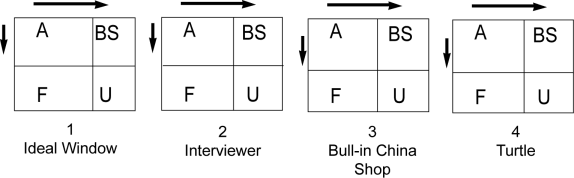
The Unknown Window - The Turtle...suggests a person who characteristically participates by observing. If you are in this window, you do not know much about yourself, nor does the group know much about you. You may be the silent member in the group who neither gives nor asks for feedback. Group members find it difficult to know where you stand in the group or where they stand with you. You are the mystery person. You appear to have a shell around you, insulating you from other group members. If group members confront you about your lack of participation, you may respond with, "I learn more by listening." While you may find it painful to participate actively, you will learn considerably more than you would if you choose to participate passively. Your shell keeps people from getting in and you from getting out. You will expend a considerable amount of energy maintaining a closed system because of the pressure which group norms exert on your behavior.
The Blind Spot Window - Bull-in-the-China Shop...suggests a person who characteristically participates primarily by giving feedback but soliciting very little. If you are in this window, you tell the group what you think of them, how you feel about what is going on in the group, and where you stand on group issues. You may lash out at group members or criticize the group as a whole and view your actions as being open and above board. For some reason, you either appear to be insensitive to the feedback you get or do not hear what group members tell you. Either you may be a poor listener or you may respond to feedback in such a way that group members are reluctant to continue to give you feedback. Members get angry, cry, threaten to leave. As a consequence, you do not know how you are coming across to other people or what impact you have on others. Because you do not correct your actions when you receive group feedback, you appear out of touch, evasive, or distorted. You continue to behave ineffectively because of your one-way communication (from you to others). Since you are insensitive to the groupĂ‚’s steering function, you do not know what behaviors to change.
The Large Facade Window - The Interviewer...suggests a person who characteristically participates by asking questions but not giving information or feedback. If you are in this window, the size of your Facade relates to the amount of information you provide to others. You may respond to the group norm to maintain a reasonable level of participation by asking for information. You intervene by asking questions such as: "What do you think about this?" "How would you have acted if you were in my shoes?" "How do you feel about what I just said?" "What is your opinion of the group?" You want to know where other people stand before you commit yourself. You do not commit yourself to the group, making it difficult for them to know where you stand on issues. At some point in your group's history, other members may have confronted you with a statement similar to this one: "Hey, you are always asking me how I feel about what's going on, but you never tell me how you feel." This style, characterized as the Interviewer, may eventually evoke reactions of irritation, distrust, and withholding.

Sunday, February 19, 2006

A Man, A Plan, A Canal, Panama

For those of you who aren't word geeks, palindromes are phrases that read the same backwards and forwards. They are very cool...such as the one in the title.

I ended up in a very neat conversation a few nights ago. Among the topics that came up was the question "What is the gospel?" My high school western history teacher had two pet questions: Why? and So What? And in order to answer those, one usually needs to know who, what, and how. I generally don't like the way people use the same religious words to communicate vastly different ideas. Actually, the practice bugs me in general, but especially with theology. Sloppy communication.

Technically gospel means "good news". Isn't that helpful? Okay, maybe this quote from an early Christian orator is more helpful. Emphasis mine.
Now, brothers, I want to remind you of the gospel I preached to you, which you received and on which you have taken your stand. By this gospel you are saved, if you hold firmly to the word I preached to you. Otherwise, you have believed in vain.

For what I received I passed on to you as of first importance: that Christ died for our sins according to the Scriptures, that he was buried, that he was raised on the third day according to the Scriptures, and that he appeared to Peter, and then to the Twelve.
Two points stand out to me. First, the definition of the gospel is of critical importance to the speaker. Salvation (from something or another) is entire contingent on holding to the gospel; the consequence of not holding onto it (or getting it wrong) is pointless belief.

Second, the phrase 'that Christ died for our sins': It is another one of those religious phrases where everyone uses the same words but means different ideas. So maybe the question is not "What is the gospel?" but "What exactly does it mean that Christ died for our sins?" and "So what does that mean for me?" See - high school history teachers are cool.

And while we're on the topic, here's an interesting post about church I stumbled across.